
A Custom Jewelry Manufacturer's Quality System in Practice
A quality system is only useful if it produces documents a buyer can check. TTT Jewelry publishes four verification layers — ISO 9001:2015, a BSCI audit, REACH compliance and CA Prop 65 plating chemistry — and one hard rule at the end of the line: 100% inspection, every piece, not a sample. The schedule around that rule is 25–30 days for master sampling and 21–28 days for bulk production.

Key takeaways
- ISO 9001:2015 governs how each production stage is controlled, not what the finished piece looks like.
- BSCI covers labour practice; REACH and CA Prop 65 cover what the metal and plating may contain.
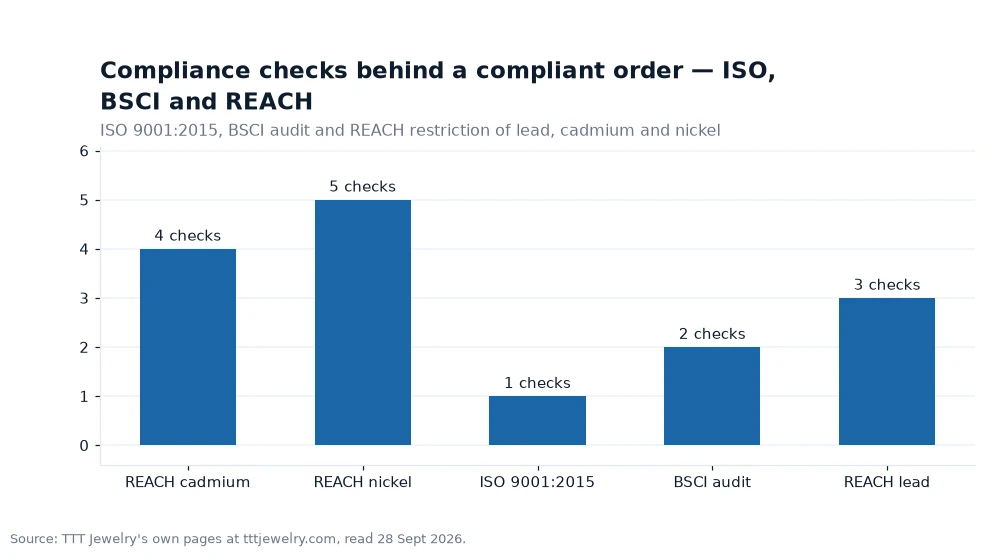
- Five compliance points sit behind a compliant order, from the audit itself to nickel release.
- Final QC is 100% inspected, so a 300-piece order means 300 individual checks, not 30.
What the system has to prove
A quality system answers three separate questions. Can the factory repeat what it approved? Can it show a buyer the record if a batch goes wrong? Can it demonstrate that the materials and coatings meet the chemical rules of the destination market? A supplier that answers only the first is describing craft skill, not a system.
The distinction matters because most defects that reach a retail shelf are not random. They come from a process that drifted — a plating bath that was not replenished, a stone lot that changed supplier, a polishing stage shortened to catch a deadline. A system exists to catch drift before it reaches the carton, and the evidence of that is documentation, not a promise.
For an OEM/ODM programme the requirement goes one step further. The factory is producing to someone else's drawings, so it also has to prove that the approved sample, the production drawing and the shipped goods are the same object. That chain — sample, spec, batch record — is what a quality audit actually tests.
ISO 9001:2015 controls the process, not the piece
ISO 9001:2015 is a management standard. It does not certify that a ring is well made; it certifies that the factory has defined how work is done, who is responsible at each stage, and how non-conforming output is handled. In jewelry terms, it applies across all production stages, from concept design through delivery.
What that looks like on the floor is less glamorous than the certificate on the wall. Written procedures for each step. A named owner for the sample bench and for the plating line. A record when a batch is pulled. A corrective action when the same fault appears twice. A buyer can ask to see the scope of the certification and the stage documents; a supplier who cannot produce them is using the standard as decoration.
The standard also sets the frame for the eight-step route: concept design, prototyping, sprue cutting, polishing, surface art, electroplating, final QC and delivery. Each step has an input, an output and a check. That structure is why the inspection points can be placed at fixed positions rather than improvised.
BSCI and REACH answer different questions
These two are often mentioned in the same sentence and they have nothing in common. The BSCI audit is a labour and social compliance exercise: working hours, wages, safety, the treatment of the people on the floor. REACH is a chemical regulation: which substances may be present in the article that reaches the customer.
Plating is where the chemical side gets specific. The published position is 100% compliance with REACH and CA Prop 65, with the metal free of lead, cadmium and nickel under REACH. That covers the alloy and the deposit, and it applies to silver, brass and stainless steel alike. A gold-coloured finish that fails a nickel release test is a recall risk regardless of how the colour was achieved.
A BSCI audit, by contrast, tells a buying team whether a factory is a place they are willing to source from. It says nothing about cadmium. Buyers who treat the two as a single "certification" tend to ask the wrong question and accept the wrong document.
| Compliance point | What it covers | Evidence to request |
|---|---|---|
| ISO 9001:2015 | Quality management across production stages | Certificate scope and stage procedures |
| BSCI audit | Labour and social compliance | Audit report with date and grade |
| REACH lead | Restricted content in the alloy and coating | Material declaration per metal |
| REACH cadmium | Restricted content in the alloy and coating | The same declaration, cadmium line |
| REACH nickel | Release from items in skin contact | Release test record per style |
A base metal chosen for the first time is the usual place to start. A custom brass jewelry programme carries the same REACH limits as a silver one, but the anti-tarnish coat adds a second layer that also has to be declared, so the paperwork is slightly longer even though the alloy is less expensive.
The table is deliberately narrow. Each row corresponds to something a supplier either has or does not have. A declaration that lists lead but omits cadmium is incomplete; an audit report that is five years old is a historical document. The value of the list is that it turns a vague request for "compliance" into five specific asks.
Five inspection points and a 100% final gate
Inspection in a jewelry line is not one event. The published process places checks after casting, after setting, after polishing, after plating and before packing. Each catches a different family of faults: porosity and incomplete fills at casting, loose stones at setting, surface scratches at polishing, colour and adhesion at plating, and final presentation before the carton.
The last gate is the one that carries the strongest published claim. Final QC inspects 100% of pieces. That is a statement about coverage, not about perfection: every unit passes a bench, and every unit can be rejected there. For a buyer, the practical consequence is that the reject rate discussion belongs at final QC, not at the sample stage.
Five checkpoints also spread risk. A fault introduced at casting and missed there will normally surface again at plating, where the deposit highlights porosity. A loose stone that survives setting is usually caught before packing. The system works because the same piece is seen more than once, by different hands, with a different question each time.
Where the chain is weakest is at hand-offs. A tray that moves from polishing to plating without a traveller ticket can lose its design identity, and a lost identity is how the wrong finish ends up on the right shape. The TTT Jewelry Manufacturer page describes a dedicated project manager for each order, which is the human equivalent of that traveller ticket: one person accountable for the piece across all five checks.
Worked example
Take a three-design brass order at the published minimum of 100 pieces per design. Units are 3 × 100 = 300. At 100% final inspection, that is 300 pieces through the last gate. A 10% sample would have been 300 × 0.10 = 30 pieces, so the published rule multiplies the final check by ten.
Now place the checkpoints against the calendar. CAD takes under 48 hours, or 2 days. Sampling runs 25–30 days, so CAD is 2 ÷ 25 = 8% of the short window and 2 ÷ 30 = 6.7% of the long one. Production adds 21–28 days. Against a total route of 48–60 days, the sampling block accounts for 25 ÷ 48 = 52% of the fast schedule and 30 ÷ 60 = 50% of the slow one, which makes approval the largest single block a buyer can still control.
Rebuild the same arithmetic for silver at 50 pieces per design. Three designs give 3 × 50 = 150 units, which is exactly half the brass count at the same design number, because 50 ÷ 100 = 0.5. The inspection rule does not change; the volume through each gate halves, and the sampling window stays at 25–30 days either way.
Frequently asked questions
Does ISO 9001:2015 mean the jewelry is high quality?
No. It means the factory documents and controls its processes, so quality can be audited and repeated rather than depending on individual skill.
Is a BSCI audit a chemical test?
No. BSCI examines labour and social conditions on site, while chemical limits on lead, cadmium and nickel come under REACH and CA Prop 65.
What does 100% inspection change for a buyer?
Every piece passes the final gate, so the number of checks equals the order quantity rather than a fraction of it.
What to request before the first purchase order
Four documents cover most of the ground: the ISO 9001:2015 certificate with its scope, the current BSCI report, a material declaration per metal, and a nickel release record for any style that touches skin. Ask for them before sampling, not after, because a gap found late is a delay with a purchase order attached to it.
The material question is where most of the risk sits. A silver programme at a 50-piece minimum can afford a tighter declaration than a brass programme at 100 pieces, but neither can skip the cadmium line. Buyers moving between metals should read the sterling silver jewelry manufacturer page and the brass page side by side, since the chemistry rules are shared while the process routes are not.
Finally, match the documents to the order. A quality system that is described in general terms and never cited in a purchase order has no effect on the batch in front of you. The five checkpoints and the 100% final gate are only real when they appear as acceptance terms.
Source note: figures come from the manufacturer's own website (tttjewelry.com), read 28 Sept 2026.[1]