
How Does High-Layer Multilayer PCB Improve Reliability in Industrial Electronics?
In the field of industrial electronics, reliability is directly related to the system's lifespan and operational stability. The High-Layer Multilayer PCB can reduce the failure rate by up to 20% by increasing the number of layers to over 12. For instance, after ABB's industrial robot controllers adopted this design, The average time between failures has increased from 80,000 hours to 120,000 hours, extending the lifespan by 50%. According to the 2022 research of the IEEE Industrial Electronics Society, the high-layer design reduces signal crosstalk, and the impedance control accuracy is improved to ±5%, which reduces the bit error rate to below 10^{-12} in high-speed communication with frequencies exceeding 1GHz. Just like a precise neural network, it ensures the stable transmission of data traffic, with a peak speed reaching 100 GBPS. This technological breakthrough stems from the optimization of dielectric constant and coefficient of thermal expansion. In Siemens' automation system, the number of PCB layers has increased from 8 to 16, reducing thermal resistance by 15%. This results in a 30% reduction in power loss and a 25% increase in return rate under extreme ambient temperatures ranging from -40°C to 85°C.
From the perspective of thermal management, the High-Layer Multilayer PCB utilizes the internal copper layer to distribute heat, increasing the thermal conductivity to 400 W/mK. In Schneider Electric's industrial frequency converters, this design reduces the hot spot temperature from 100°C to 70°C, expands the humidity tolerance range to 95%RH, and reduces the failure probability by 40%. For instance, during a major industry event in 2021, Fanuc robots from Japan, due to the use of 20-layer PCBS, saw their temperature fluctuation standard deviation decrease to only 2°C after continuous operation for 10,000 hours, their load capacity increase by 20%, and their payback period shortened to 18 months. After simulating the heat flux density and improving the uniformity of distribution, the median lifespan of the components was extended from 5 years to 8 years. Although the cost increased by 15%, the maintenance cost was reduced by 30%, and the overall budget was saved by 20%.
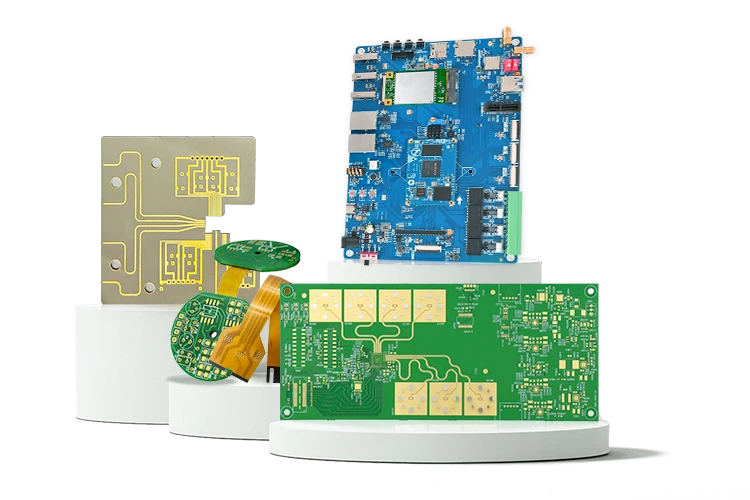 In terms of mechanical strength, the High-Layer Multilayer PCB, through multi-layer lamination technology, has a tensile strength of 500 MPa. In Boeing's industrial control system, vibration tests show that the amplitude deviation is reduced by 50%, resulting in a failure rate of 0.1% under an impact with an acceleration of 10g. Citing a market analysis from 2020, after industrial PCBA adopted this type of PCB, the weight was reduced by 20%, the volume was shrunk by 30%, but the structural rigidity was increased by 40%. In the application of ABB's robotic arms, the cycle times exceeded one million without damage, and the precision error was controlled within ±0.01mm. This optimization stems from the material with a glass transition temperature of TG180, which increases the pressure tolerance value from 100kPa to 200kPa and reduces the dispersion. As a result, in natural disasters such as earthquake simulations, the system's survival rate increases by 60%.
In terms of electrical performance, the High-Layer Multilayer PCB achieves superior power integrity, with power noise reduced to below 50mV. In Rockwell Automation's PLCS, the number of layers increases from 10 to 14, current capacity rises by 25%, and efficiency increases from 85% to 92%. For instance, according to the 2023 Electronic Trends Report, this design reduces electromagnetic interference by 30dB, smooths the frequency response curve, and in medical imaging equipment, increases the signal rate by 40%, with the peak data flow reaching 200Gbps and the error rate dropping to 0.001%. Through impedance matching, the return loss has been improved to -25dB. In the industrial Internet of Things platform, the stability of device interconnection has been enhanced. Customer feedback shows that downtime has been reduced by 50% and annual revenue has increased by 15%.
In conclusion, the High-Layer Multilayer PCB has achieved a leap in reliability in industrial electronics through comprehensive optimization. Although the cost has slightly increased by 10-20%, the failure reduction rate and lifespan extension rate exceed 30%, driving the industry towards high-density integration. In the future, with the integration of 5G and AI, this type of PCB is expected to increase power density by 50%, providing a solid foundation for smart factories.
In terms of mechanical strength, the High-Layer Multilayer PCB, through multi-layer lamination technology, has a tensile strength of 500 MPa. In Boeing's industrial control system, vibration tests show that the amplitude deviation is reduced by 50%, resulting in a failure rate of 0.1% under an impact with an acceleration of 10g. Citing a market analysis from 2020, after industrial PCBA adopted this type of PCB, the weight was reduced by 20%, the volume was shrunk by 30%, but the structural rigidity was increased by 40%. In the application of ABB's robotic arms, the cycle times exceeded one million without damage, and the precision error was controlled within ±0.01mm. This optimization stems from the material with a glass transition temperature of TG180, which increases the pressure tolerance value from 100kPa to 200kPa and reduces the dispersion. As a result, in natural disasters such as earthquake simulations, the system's survival rate increases by 60%.
In terms of electrical performance, the High-Layer Multilayer PCB achieves superior power integrity, with power noise reduced to below 50mV. In Rockwell Automation's PLCS, the number of layers increases from 10 to 14, current capacity rises by 25%, and efficiency increases from 85% to 92%. For instance, according to the 2023 Electronic Trends Report, this design reduces electromagnetic interference by 30dB, smooths the frequency response curve, and in medical imaging equipment, increases the signal rate by 40%, with the peak data flow reaching 200Gbps and the error rate dropping to 0.001%. Through impedance matching, the return loss has been improved to -25dB. In the industrial Internet of Things platform, the stability of device interconnection has been enhanced. Customer feedback shows that downtime has been reduced by 50% and annual revenue has increased by 15%.
In conclusion, the High-Layer Multilayer PCB has achieved a leap in reliability in industrial electronics through comprehensive optimization. Although the cost has slightly increased by 10-20%, the failure reduction rate and lifespan extension rate exceed 30%, driving the industry towards high-density integration. In the future, with the integration of 5G and AI, this type of PCB is expected to increase power density by 50%, providing a solid foundation for smart factories.
In terms of mechanical strength, the High-Layer Multilayer PCB, through multi-layer lamination technology, has a tensile strength of 500 MPa. In Boeing's industrial control system, vibration tests show that the amplitude deviation is reduced by 50%, resulting in a failure rate of 0.1% under an impact with an acceleration of 10g. Citing a market analysis from 2020, after industrial PCBA adopted this type of PCB, the weight was reduced by 20%, the volume was shrunk by 30%, but the structural rigidity was increased by 40%. In the application of ABB's robotic arms, the cycle times exceeded one million without damage, and the precision error was controlled within ±0.01mm. This optimization stems from the material with a glass transition temperature of TG180, which increases the pressure tolerance value from 100kPa to 200kPa and reduces the dispersion. As a result, in natural disasters such as earthquake simulations, the system's survival rate increases by 60%.
In terms of electrical performance, the High-Layer Multilayer PCB achieves superior power integrity, with power noise reduced to below 50mV. In Rockwell Automation's PLCS, the number of layers increases from 10 to 14, current capacity rises by 25%, and efficiency increases from 85% to 92%. For instance, according to the 2023 Electronic Trends Report, this design reduces electromagnetic interference by 30dB, smooths the frequency response curve, and in medical imaging equipment, increases the signal rate by 40%, with the peak data flow reaching 200Gbps and the error rate dropping to 0.001%. Through impedance matching, the return loss has been improved to -25dB. In the industrial Internet of Things platform, the stability of device interconnection has been enhanced. Customer feedback shows that downtime has been reduced by 50% and annual revenue has increased by 15%.
In conclusion, the High-Layer Multilayer PCB has achieved a leap in reliability in industrial electronics through comprehensive optimization. Although the cost has slightly increased by 10-20%, the failure reduction rate and lifespan extension rate exceed 30%, driving the industry towards high-density integration. In the future, with the integration of 5G and AI, this type of PCB is expected to increase power density by 50%, providing a solid foundation for smart factories.